
On August 28, the Hawaiʻi Board of Land and Natural Resources (BLNR) declined to advance proposed rules that would have created a pathway to reopen commercial aquarium collection in Hawaiʻi.
Commercial aquarium collection was not reopened. Instead, the Board remanded the proposed rules back to the Division of Aquatic Resources (DAR) for further legal, technical, and cultural review, including further consideration of alternatives under the public trust.
The decision followed an extraordinary showing of opposition. More than 850 pieces of written testimony opposing the proposed rules were submitted to the Board, nearly 300 through Surfrider’s action alert.
At the August 28th meeting, over six hours, the board heard testimony from nearly 70 people passionately opposing the trade. A number of collectors and supporters of the industry also showed up. Collectors and supporters of the aquarium industry also showed up, emphasizing the importance of the industry to those who participate in it.
What stood out in the testimony opposing reopening was a different lens: a long-term vision grounded in memories of what abundant reefs once looked like, and a determination to restore that abundance once again. Lineal descendants, cultural practitioners, subsistence fishermen, and community advocates who have fiercely defended these reefs and fisheries for decades flew in from across Hawaiʻi Pae ʻĀina. They were joined by county councilmembers, state legislators, scientists, conservationists, and keiki, speaking to what healthy, abundant reefs mean for communities, cultural practice, future generations, and Hawaiʻi as a whole.
Across generations, islands, backgrounds, and relationships to the ocean, the message was remarkably consistent:
Keep Hawaiʻi’s Reef Fish on the Reef.
Joining a Fight Decades in the Making
Surfrider is honored to stand alongside the cultural practitioners, fishers, lineal descendants, and community advocates who have been fighting to protect Hawaiʻi’s reef fish for decades.
Over the past year, we have worked to add our voices to that much longer movement—from supporting legislation that would have prohibited the trade, to opposing the Oʻahu aquarium fishery EISPN, to supporting county-level action that ultimately saw all four county councils take a stand against reopening commercial aquarium collection.
As the August 28 BLNR hearing approached, the biggest decision point yet, we wanted to activate every part of our network and find creative ways to bring more voices into the process.
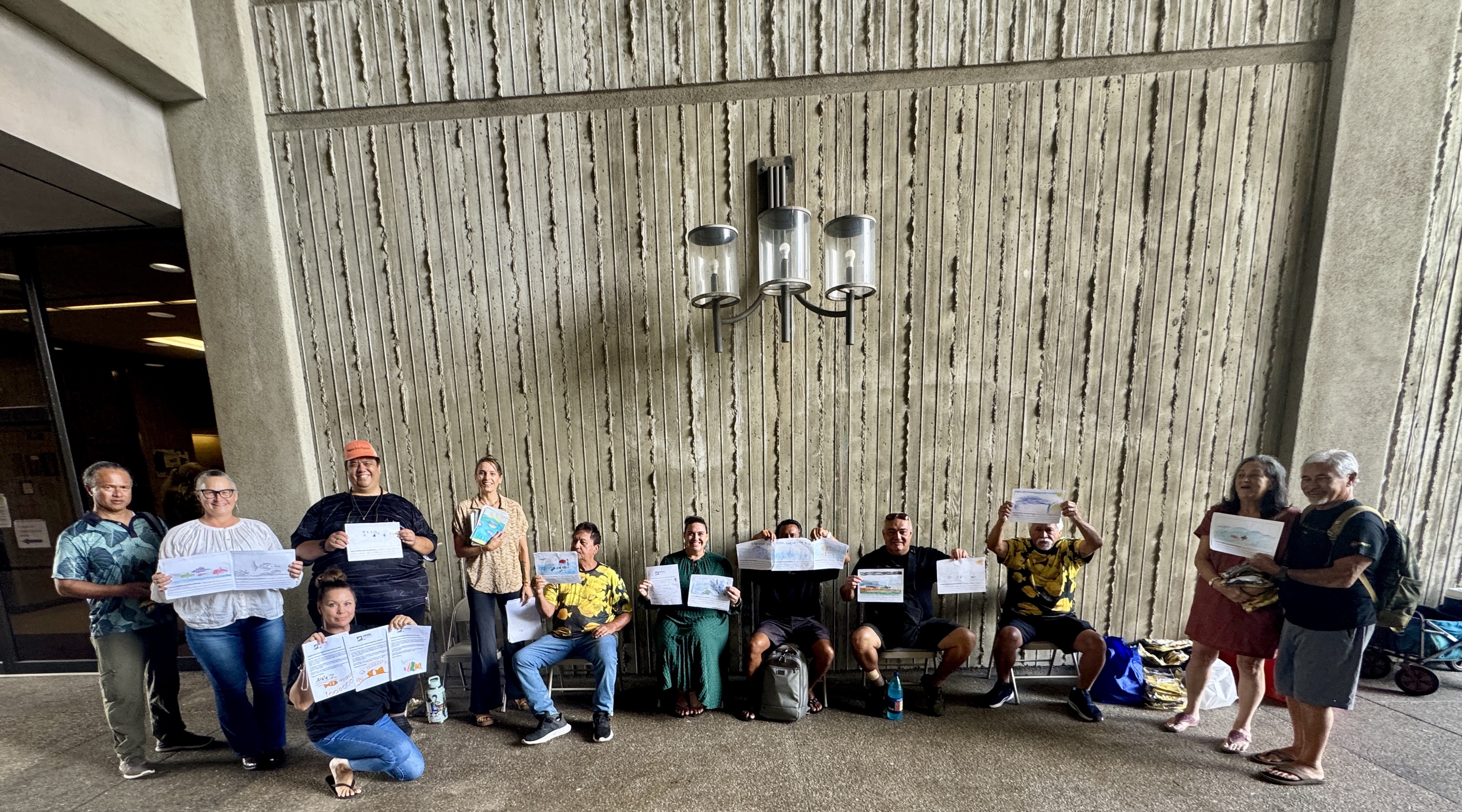
On Kauaʻi, the Surfrider Kauaʻi Chapter gathered 170 petition signatures calling for reef fish to remain on the reef. At the Limu Festival in Anahola, keiki added their own voices through a petition and artwork.
And we took the campaign into classrooms.
First graders at Alakaʻi O Kauaʻi and second graders at ʻEleʻele Elementary School drew pictures and wrote messages explaining why they wanted Hawaiʻi’s reef fish to stay on the reef. On Maui, third graders at King Kamehameha III Elementary School each chose a favorite reef fish and created watercolor postcards to BLNR, painting their fish on the front and writing a message inside. All together, we collected 71 pieces of keiki testimony.
Hawaiʻi Regional Manager Hanna Lilley carried these voices into the Board room, emphasizing that the children whose testimony she shared have perhaps the greatest stake in decisions about the future of Hawaiʻi’s reefs. She shared their messages and distributed their testimony to Board members, leaving them with a simple reminder: these keiki may not speak in terms of public trust or cumulative stress, but they know what is at stake. They understand that these fish are part of something larger—that the fish, the reef, the ocean, and their own futures are intertwined.
Their voices landed. Over the remaining hours of the proceeding, Board members had the keiki testimony in front of them. Their messages were referenced multiple times during deliberations, keeping the voices of the next generation front and center as the Board wrestled with its decision.
Their impact extended beyond the Board. For advocates who have fiercely defended these reefs and fisheries for years—and, in some cases, decades—the keiki offered something equally powerful: hope. For those who have spent years fighting for the abundance they remember, seeing that same care and connection reflected in the next generation was a powerful reminder of why the fight is worth continuing.


The Board sends the rules back
After nearly five hours of public testimony and lengthy deliberation, BLNR did not approve DAR’s proposed rules. Instead, the Board remanded the proposal back for further review, recognizing legal issues with the proposed framework and directing the Department to reconsider alternatives to commercial collection, including whether commercial collection is consistent with the State’s constitutional public trust obligations and its duty to protect Native Hawaiian traditional and customary practices.
The Board did not take the additional step Surfrider and many community members had requested which would direct DAR to prohibit commercial aquarium collection statewide, but it also did not allow the proposed reopening framework to move forward.
DAR will now revisit the public rulemaking process, potentially including another round of public hearings. For now, commercial aquarium collection remains closed statewide and the door remains open for Hawaiʻi to choose a different path.
This fight is not over. But August 28 showed the power of a community willing to fight for a future where we don’t simply manage the decline of precious natural resources, but instead make decisions rooted in abundance, cultural practice, and long-term stewardship. A future we can be proud to leave our keiki.
Read Surfrider Foundation’s full written testimony here.
Watch the BLNR hearing recording (Surfrider keiki testimony begins at 7:47).
 Prior to her role as Hawai`i Regional Manager and Maui Fire Response Coordinator, Hanna has had a long history in non-profit leadership and environmental conservation in Hawai`i. With a Bachelor's degree in Biology she moved to Maui in 2013 where she spent the next decade working as a restoration technician.