
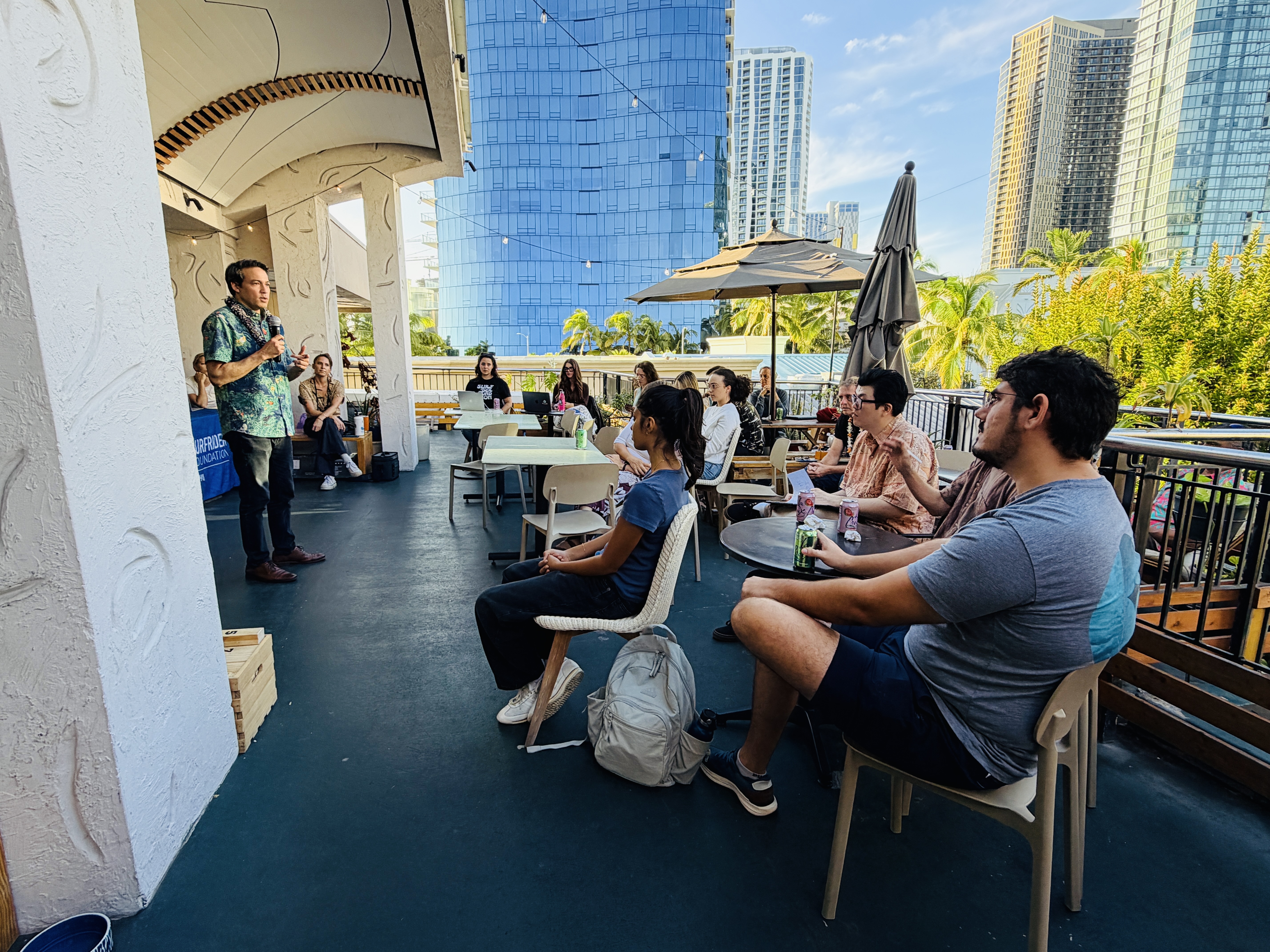
Participation, when organized, becomes power. And power, when applied strategically, creates lasting change.
This year, the Oʻahu Chapter’s annual Stoked on Civics legislative training expanded to include the entire Hawaiʻi Region, bringing together advocates from across the islands to deepen their understanding of how policy change actually happens. (You can find the recording of the webinar below.)
The program opened with remarks from Senator Chris Lee, who represents Kailua, Waimānalo, and Hawaiʻi Kai and now chairs the Senate Committee on Water, Land, Culture and the Arts — one of the most influential committees shaping coastal policy in the State. As Senator Lee commented in a recent HPR interview, ʻ‘If our beaches are the center of our communities, our way of life, and certainly our economy, what are we going to do to protect them, and what is it worth to protect them?’. Following this sentiment, Senator Lee spoke to the importance of preserving natural shoreline processes and protecting public trust resources.
Over the past several years, Hawaiʻi’s shoreline policy has increasingly shifted away from broad-scale hardening and toward temporary, limited measures. Coastal communities are actively searching for long-term solutions, and leadership at the Legislature plays a critical role in determining whether we move toward reactive crisis management or proactive shoreline stewardship. His remarks reinforced an important truth: policy is not made in a vacuum. From showing up as an individual to multiplying voices at the capitol, organized civic engagement shapes the lawmaking process.
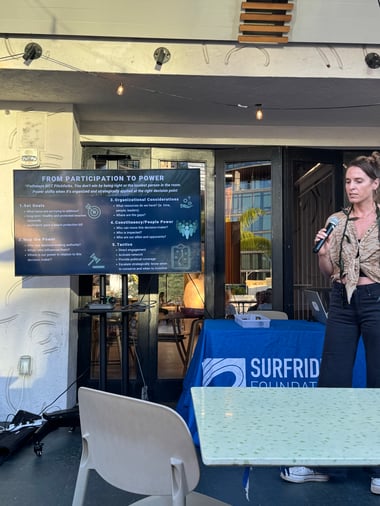
Following Senator Lee’s remarks, the training grounded participants in a broader framework for civic engagement. Civics, defined as the individual and collective actions designed to identify and address issues of public concern is a broad term. We focused on how civic engagement can be used as a tool to address power systems- thats where Direct Action Organizing (DAO) comes into play.
Direct Action Organizing is about winning concrete improvements in people’s lives, building awareness of collective power, and shifting structural relationships to power. It transforms participation into durable influence and systemic change. Surfrider’s work reflects these principles: building a base through programs, developing leaders, advancing strategic campaigns, and ultimately building a movement.
The group then walked through how this framework applies inside the Legislature and how successful organizing is about ‘Pathways not Pitchforks’. Being correct is not a strategy. Outrage is not a strategy. Being loud is not the same as building power. Power shifts when it is organized and strategically applied at the right decision point. “Pathways, not pitchforks” means mapping the pathway to change — identifying who holds decision-making authority, what influences them, who can move them, and how to best mobilize.
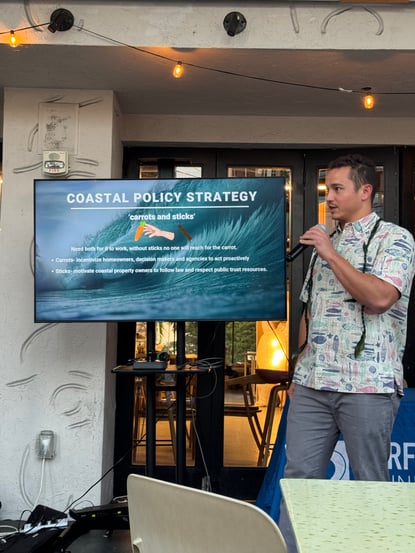
Colin Lee, SOEST policy manager, demystified the legislative process by walking participants through a bill’s journey — from referral and committee hearings to conference and final passage. He covered how to set up an account on capitol.hawaii.gov, track measures, submit testimony, and engage meaningfully at each stage. Colin also walked through coastal policy strategy as a balance of carrots and sticks and how that applies to our coast and climate priorities this session.
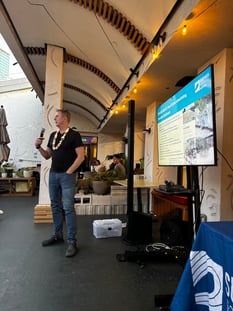
Building on that foundation, participants heard from Michael Cain, Director of the Office of Conservation and Coastal Lands (OCCL), who walked attendees through one of Surfrider’s priority measures, SB3035. The bill would require upfront and specific shoreline erosion disclosures at the real estate advertising stage for oceanfront parcels.
Director Cain shared what OCCL is observing in the current real estate market. Longtime Hawaiʻi residents are often aware of documented shoreline instability, active erosion, and unresolved violations — and many will not purchase a multi-million-dollar oceanfront property with known erosion risk. However, newer buyers, particularly those purchasing remotely, may rely heavily on online marketing that emphasizes lifestyle and views without clearly conveying erosion history or enforcement issues. SB3035 is designed to improve transparency at the earliest stage of the transaction process, allowing buyers to make informed decisions before entering into contracts. Early disclosure protects consumers, reduces pressure for post-purchase emergency shoreline armoring, and ultimately helps safeguard public trust resources.
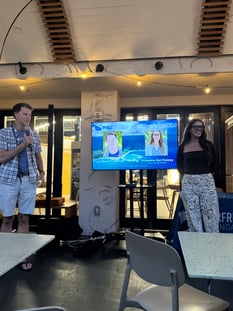
Stuart Coleman and Jessica Paisley of Wastewater Alternatives and Innovations shared their approach to addressing Hawaiʻi’s cesspool pollution crisis. They highlighted priority measures aimed at reducing cesspool impacts on coastal waters, increasing agency capacity, updating administrative rules, and making conversions more affordable for homeowners.
Throughout the training, one message remained clear: civic engagement in the legislative process matters. Recruiting like-minded advocates and amplifying voices together is far more powerful than acting alone. While sending an email is a starting point, making a phone call, attending a hearing, and sharing a personal story in person carries even greater impact. Policy is shaped by people who show up — strategically, consistently, and together.
 Prior to her role as Hawai`i Regional Manager and Maui Fire Response Coordinator, Hanna has had a long history in non-profit leadership and environmental conservation in Hawai`i. With a Bachelor's degree in Biology she moved to Maui in 2013 where she spent the next decade working as a restoration technician.